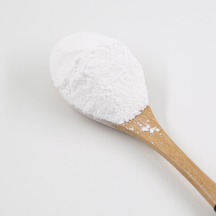
Carrageenan is a common food ingredient you’ve likely seen on labels, yet many people still wonder what it really is and why it’s used. Derived from red seaweed, carrageenan plays a key role in improving texture, stability, and consistency across modern foods. In this guide, we’ll explore what carrageenan is, how it’s made, the different types of carrageenan, and where it appears in food and non-food products, helping you better understand its function and safety in everyday diets.
Carrageenan is a naturally derived ingredient that plays a quiet but important role in many everyday foods. It comes from red seaweed and has been used in food preparation for generations, long before modern food processing existed. Today, it helps products stay smooth, stable, and consistent, even when they are stored, transported, or reheated.
From a scientific point of view, carrageenan is a natural polysaccharide, meaning it is made up of long chains of sugar molecules. We don’t consume it for nutrition, but foods rely on it for structure and texture. You’ll often find it working behind the scenes in dairy products, plant-based alternatives, sauces, and desserts, where it helps ingredients blend and remain evenly distributed.
On ingredient labels, carrageenan may appear under several different names. These include Irish moss, carrageen moss, or E407 in European food labeling systems. Although the names vary, they all refer to the same seaweed-derived substance used for its functional properties.
| Name Used on Labels | Context |
|---|---|
| Carrageenan | Standard ingredient lists |
| Irish moss | Traditional or historical use |
| Carrageen moss | Older scientific references |
| E407 | European additive classification |
Carrageenan is produced from red seaweed, scientifically classified as Rhodophyceae. These marine plants grow naturally in coastal waters and have been harvested for centuries as a food-related resource. Unlike many land plants, red algae contain unique compounds in their cell walls that make carrageenan possible.
Red algae are especially suitable for carrageenan production because they naturally contain sulfated galactose-based polymers. These compounds respond well to gentle extraction processes and form gels or thick solutions when combined with water, proteins, or certain minerals. That behavior is what makes carrageenan so valuable in food applications.
Several factors explain why red seaweed works so well for this purpose:
It naturally produces polysaccharides with strong binding properties
Its molecular structure supports thickening, stabilizing, and gelling
It grows quickly in marine environments without farmland or freshwater
During production, the seaweed is cleaned, extracted, and refined to isolate the functional components already present in the plant. The process focuses on preserving what nature provides, rather than creating new synthetic substances.
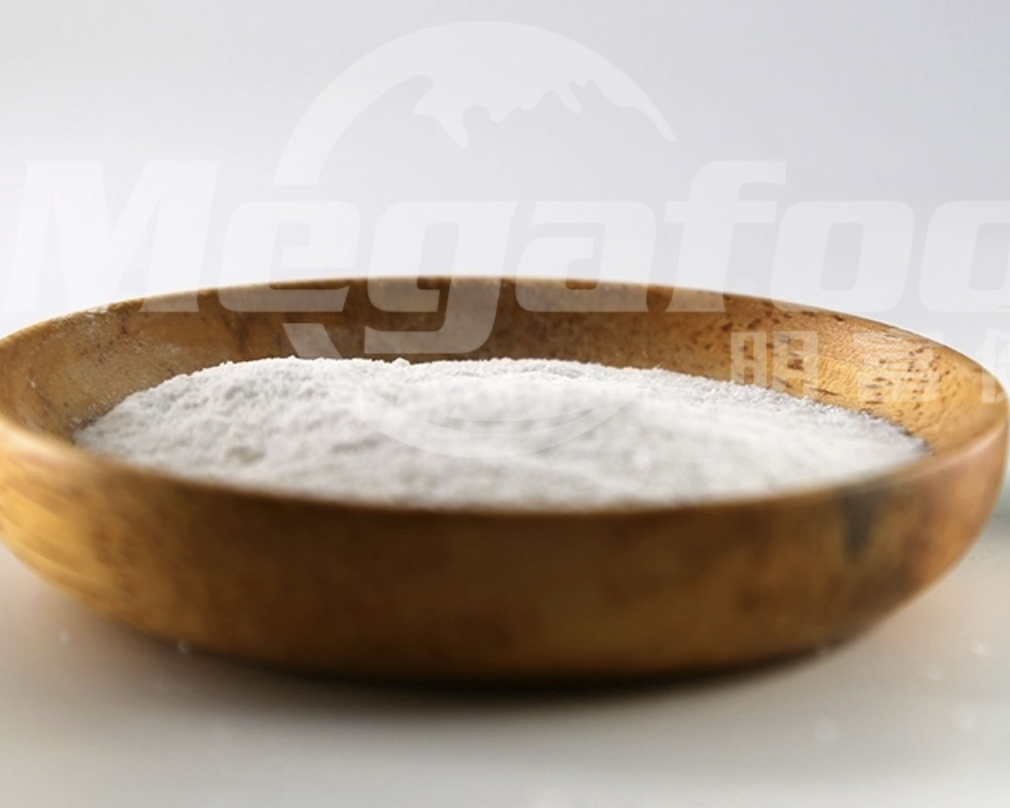
Not all carrageenan behaves the same in food. In practice, manufacturers mainly rely on three types, each chosen for a specific texture or function. They all come from red seaweed, but their structures differ slightly, which changes how they perform.
κ-carrageenan (kappa) is best known for forming firm gels. It’s often used in dairy and meat products, where it helps create a clean cut and a stable shape. You’ll see it in foods that need structure rather than flow. It also reacts strongly to potassium salts, which strengthens its gel.
ι-carrageenan (iota) forms softer, more elastic gels. Instead of snapping cleanly, it bends and holds moisture well. Food producers like it for creamy textures, especially in products that need freeze–thaw stability. It interacts well with calcium, which gives it flexibility.
λ-carrageenan (lambda) does not form a gel at all. It works as a thickener instead, increasing viscosity while staying fluid. This makes it useful in sauces, dressings, and beverages where smooth pouring matters.
| Type | Main Function | Typical Texture |
|---|---|---|
| κ-carrageenan | Gelling | Firm, brittle |
| ι-carrageenan | Gelling | Soft, elastic |
| λ-carrageenan | Thickening | Smooth, fluid |
Each type of carrageenan influences texture in a different way. Some create structure, others add body, and some simply keep ingredients evenly mixed. Food formulators choose based on how the product should feel in your mouth.
Here’s how they generally behave:
Gelling: Kappa and iota carrageenan create networks that trap water
Thickening: Lambda carrageenan increases thickness without setting
Stabilizing: All three help prevent separation over time
Their performance also depends on how they interact inside food systems. Carrageenan responds strongly to proteins, especially milk proteins, which helps stabilize chocolate milk and dairy alternatives. Salts influence strength and elasticity, while water activates the entire structure.
In real foods, they rarely work alone. They interact, adjust, and balance texture so products stay consistent from the first bite to the last.
Carrageenan starts its journey in coastal waters, where red seaweed is harvested, cleaned, and prepared for extraction. Once dried, the seaweed goes through an alkaline extraction process. This step uses a mild alkaline solution to release the functional polysaccharides locked inside the seaweed’s cell walls. Heat helps speed things up, allowing the useful compounds to dissolve into liquid.
After extraction, the mixture is filtered to remove solid plant material. What happens next depends on the type of carrageenan being produced. At this stage, producers decide between semi-refined and refined carrageenan, based on the intended food application.
| Type | How It’s Processed | Typical Use |
|---|---|---|
| Semi-refined carrageenan | Dried and milled after extraction | Meat products, pet food |
| Refined carrageenan | Further purified and precipitated | Dairy, beverages, desserts |
Semi-refined carrageenan keeps more of the original seaweed structure. Refined versions go through extra steps, such as alcohol precipitation or controlled gel formation, to achieve higher purity and consistent performance.
This question comes up often, especially when people compare carrageenan to artificial additives. While it is processed, it doesn’t fit the definition of a synthetic ingredient. It begins as a whole marine plant, and processing focuses on separation rather than chemical creation.
Synthetic additives are usually built molecule by molecule. Carrageenan already exists in seaweed. Processing simply isolates it so food makers can use it safely and predictably. Without processing, texture, strength, and stability would vary too much from batch to batch.
Processing also serves practical purposes:
It removes unwanted residues from raw seaweed
It improves food safety and shelf stability
It allows precise control over gelling or thickening behavior
In short, processing makes carrageenan usable. It helps foods stay consistent, safe, and familiar, even when stored, shipped, or reheated.
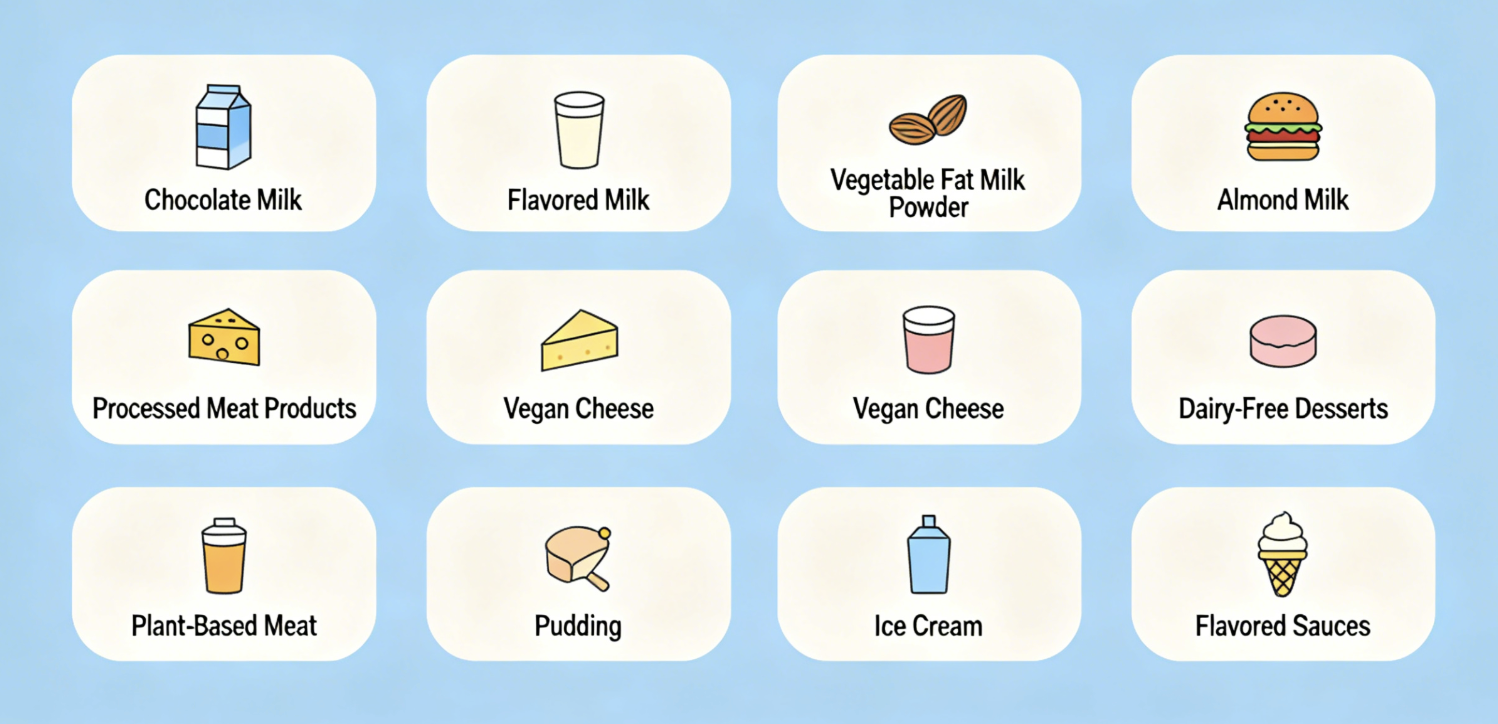
Carrageenan shows up in many everyday foods, often in small amounts. You might not notice it, but it helps keep texture smooth and ingredients evenly mixed. Food producers rely on it when consistency matters across batches. In dairy products and dairy alternatives, carrageenan helps prevent separation. You’ll often find it in chocolate milk, flavored milk, creamers, and plant-based drinks like almond or oat milk. It keeps cocoa suspended and improves mouthfeel.
For processed meats and deli products, it supports moisture retention. It helps sliced meats hold their shape while staying tender. They also use it to reduce fat or salt without sacrificing texture. Plant-based and vegan foods depend on carrageenan for structure. It acts as a plant-friendly alternative to gelatin. Vegan cheeses, non-dairy desserts, and meat substitutes often rely on it to create a familiar bite.
In desserts, sauces, and beverages, carrageenan adds body and stability. It thickens puddings, smooths ice cream, and helps sauces stay uniform. In drinks, it keeps ingredients from settling at the bottom.
| Food Category | Common Examples |
|---|---|
| Dairy | Chocolate milk, ice cream, creamers |
| Meat products | Deli meats, sausages |
| Plant-based foods | Vegan cheese, dairy-free desserts |
| Sauces and drinks | Salad dressings, flavored beverages |
Carrageenan isn’t limited to food. Its stabilizing properties make it useful in several non-food applications. You may encounter it without realizing it. In pharmaceuticals and supplements, it helps control texture and release. It appears in syrups, capsules, and gel-based medicines. They use it to keep formulations stable over time.
Cosmetics and personal care products also rely on carrageenan. It thickens lotions, improves gel consistency, and enhances spreadability. Skin creams and hair products often include it for a smooth feel. You’ll even find it in toothpaste, gels, and medical formulations. It helps toothpaste stay uniform and easy to dispense. In medical settings, it supports gels and diagnostic preparations where consistency is critical.
Carrageenan often works behind the scenes. It helps food makers control costs while keeping products consistent. That balance matters when brands try to offer stable prices at scale.
Carrageenan supports efficiency during large-scale production. It improves texture using small amounts, so formulas rely less on costly ingredients. That alone changes the math.
How it helps manufacturers:
Improves water binding, so finished products weigh more
Stabilizes texture, reducing failed batches
Cuts reformulation time during process changes
Works across dairy, meat, and plant-based systems
Yield improvement and waste reduction
When products hold structure better, fewer batches fail quality checks. They stay usable longer during processing. It reduces trim loss, rework, and disposal. For factories, it saves materials, energy, and labor hours.
| Production Area | Without Carrageenan | Using Carrageenan |
|---|---|---|
| Batch consistency | Variable | More stable |
| Product loss | Higher | Lower |
| Reprocessing needs | Frequent | Reduced |
| Cost per unit | Less predictable | More controlled |
Lower production costs usually flow downstream. They affect pricing, availability, and product reach. Consumers feel that, even if they never notice the ingredient.
Shelf life extension
Carrageenan helps foods keep their structure over time. They separate less. They spoil slower. Longer shelf life means fewer expired products on shelves. Retailers waste less, so pricing pressure eases.
Transportation and storage advantages
Stable texture matters during transport. Products survive freezing, thawing, and long shipping routes. They arrive in better condition. That reduces cold-chain losses and storage risks. For global markets, this stability supports wider access to affordable foods.
A:It comes from red seaweed, so it’s naturally derived. Food-grade carrageenan is processed, but it isn’t synthetic or lab-made.
A:Most studies show food-grade carrageenan is safe in normal diets. Inflammation concerns usually involve degraded forms not used in foods.
A:Yes. You can choose fresh foods or check labels. Some brands also offer carrageenan-free alternatives.
A:It isn’t required, but it helps improve texture, stability, and shelf life in many processed foods.
Carrageenan may stay invisible on your plate, but its role is easy to spot once you know what to look for. From improving texture to supporting stability, it quietly shapes how many foods feel, taste, and last. Understanding where it comes from and how it works helps you make more informed choices, whether you prefer traditional dairy, plant-based options, or carefully formulated products.
At Megafood (Shanghai) Health Technological Co., Ltd, we focus on sourcing and applying functional ingredients responsibly. If you’re exploring reliable, science-backed food solutions, we’re always happy to share expertise and support your next formulation step.