Views: 0 Author: Site Editor Publish Time: 2026-02-09 Origin: Site


Cellulose Gum vs Carrageenan: What’s the Difference? If you’ve ever checked food labels, you’ve probably seen these two common gums. They both thicken, stabilize, and improve texture, but their sources, behavior, and applications are very different. Understanding how cellulose gum and carrageenan work can help you choose the right ingredient for cooking, baking, or vegan and allergy-friendly recipes. In this guide, we’ll explore their origins, functional properties, health considerations, and tips for using them effectively in everyday foods.
Cellulose gum comes from plant cellulose, usually extracted from wood pulp or other plant fibers. They take this natural polymer and chemically modify it into carboxymethyl cellulose (CMC), which makes it easier to dissolve in water and use in foods. In the industry, it’s available in powder form or as a ready-to-use solution, giving manufacturers flexibility depending on their recipe or production needs.
It’s a thickener, stabilizer, and emulsifier all in one. Cellulose gum holds water effectively, keeping products moist and creamy. Its behavior in liquids is interesting: it’s pseudoplastic, meaning its viscosity decreases under stirring or shaking but recovers once things settle. This makes it great for keeping sauces, drinks, and gels consistent over time.
Key properties at a glance:
Holds water and prevents drying
Maintains smooth texture in liquids
Reduces separation in emulsions
Stable under different temperatures
You’ll find cellulose gum in many everyday products:
Dairy & alternatives: yogurt, creamers, plant-based milks
Frozen desserts: ice cream, sorbet
Sauces & dressings: salad dressing, ketchup, marinades
Baked goods: gluten-free breads, cakes, pastries
It’s popular because it keeps foods smooth, prevents clumping, and improves shelf life without affecting flavor.
Cellulose gum isn’t digested by our bodies, so it acts like dietary fiber. For most people, small amounts are harmless, but eating too much may cause bloating, gas, or mild digestive upset. Research on long-term effects is limited.
Comparison with other common gums:
| Gum Type | Source | Key Function | Digestibility |
|---|---|---|---|
| Cellulose Gum | Plant fibers / CMC | Thickener, stabilizer | Not digested |
| Guar Gum | Guar beans | Thickener, binder | Soluble fiber |
| Xanthan Gum | Bacterial fermentation | Thickener, emulsifier | Partially digested |
Carrageenan is a natural polysaccharide extracted from red seaweed, often called Irish moss. It comes in three main types: Kappa, Iota, and Lambda, each differing in gelling strength and texture. Food-grade carrageenan is carefully processed and safe for use in foods, while degraded carrageenan (poligeenan) is not approved for consumption due to potential health risks. Manufacturers choose types based on desired texture, clarity, and gel strength.
Carrageenan is a versatile gelling, thickening, stabilizing, and emulsifying agent. It holds water effectively, creating creamy textures in liquids. One unique property is its ability to work synergistically with other gums, like locust bean gum or konjac, improving gel elasticity and water retention. Depending on the type and preparation, it can form heat-reversible gels that melt on warming or heat-irreversible gels that stay firm after heating, offering flexibility in recipes.
Key functional highlights:
Improves texture in dairy and plant-based products
Enhances stability in sauces, puddings, and dressings
Forms gels that adjust to heat or cooling
Works well combined with other food gums
Carrageenan appears in many everyday foods:
Dairy: chocolate milk, yogurt, creamers
Plant-based alternatives: soy milk, almond milk
Meat products: deli meats, sausages
Desserts & sauces: ice cream, jellies, puddings, gravies
It’s often used to prevent separation, improve mouthfeel, and create smooth textures.
The FDA recognizes food-grade carrageenan as safe for consumption. Most concerns come from degraded carrageenan, which can cause gastrointestinal inflammation in lab studies. Research on food-grade carrageenan shows limited evidence of gut harm, though some studies explore its role in gut microbiome and inflammatory bowel disease (IBD).
Tips for consumers:
Check labels if sensitive to processed foods
Rotate products to avoid excessive intake
Prefer foods with minimal additives
Comparison Table: Cellulose Gum vs Carrageenan
| Property | Cellulose Gum | Carrageenan |
|---|---|---|
| Source | Plant fibers (CMC) | Red seaweed (Irish moss) |
| Main function | Thickener, stabilizer | Gelling, stabilizer, emulsifier |
| Water retention | High | Very high, forms gels |
| Digestibility | Not digested | Not digested |
| Common foods | Yogurt, sauces, ice cream | Dairy, plant milk, jellies |
| Special behavior | Pseudoplastic viscosity | Heat-reversible/irreversible gels |
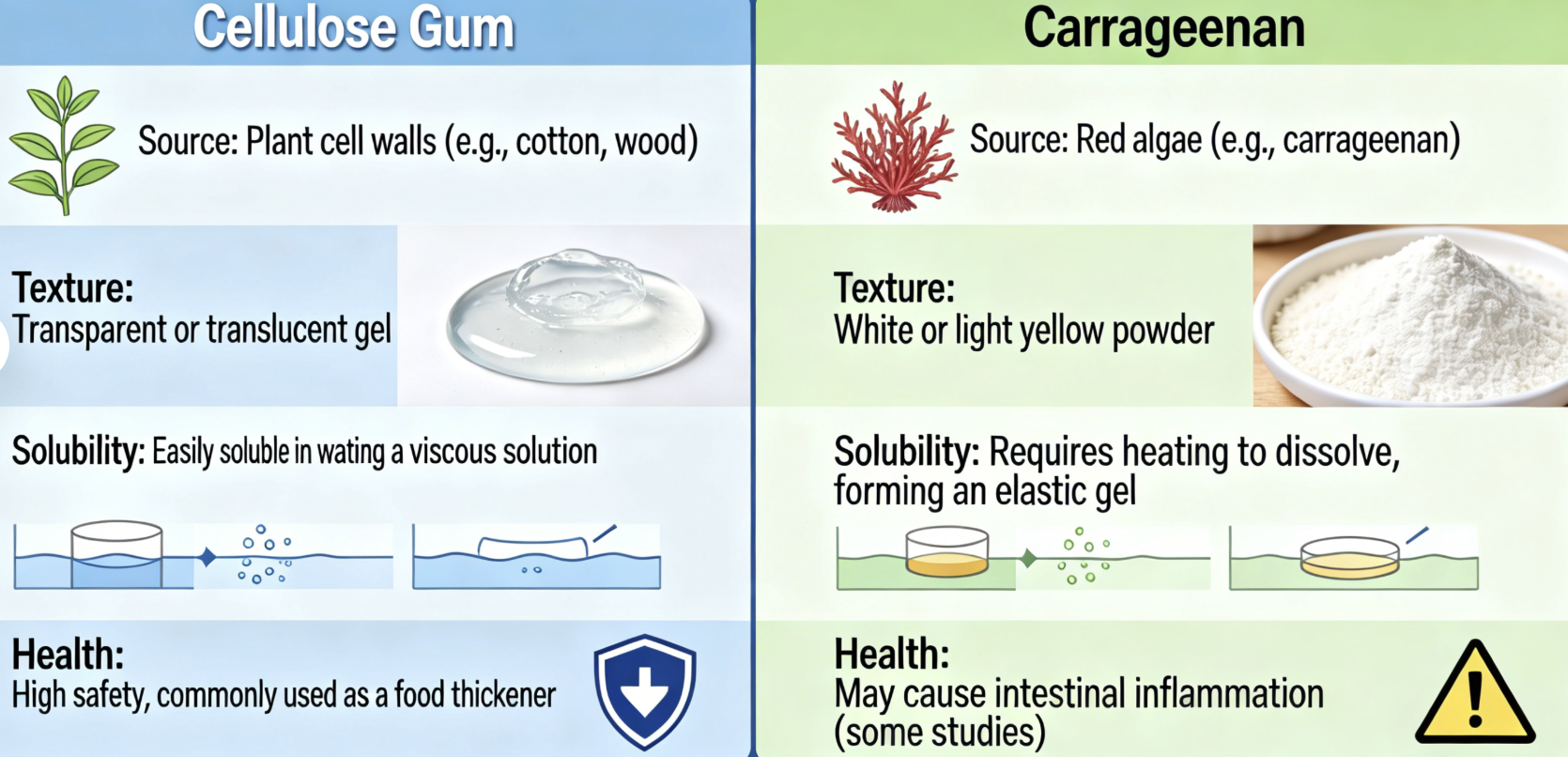
Cellulose gum comes from plant fibers, usually wood pulp or other plant-based cellulose. It’s a modified natural polymer, processed to create carboxymethyl cellulose (CMC) for food use.
Carrageenan is extracted from red seaweed, often called Irish moss. It exists in several types—Kappa, Iota, Lambda—each offering different gel strength and texture.
Cellulose gum creates a creamy, thick texture, perfect for stabilizing liquids and suspensions. It improves mouthfeel and helps prevent ingredients from separating.
Carrageenan produces a gel-like or semi-solid structure, often used to form puddings, jellies, and plant-based milks. It works well with other gums like locust bean gum or konjac, enhancing elasticity and water retention.
Quick Comparison of Texture & Function:
Cellulose gum: smooth, stabilizing, thickening
Carrageenan: gel-forming, elastic, water-binding
Cellulose gum dissolves in cold or hot water if added slowly and stirred properly. It exhibits pseudoplastic behavior, meaning it thins under shear and thickens when at rest—ideal for sauces, beverages, and dressings.
Carrageenan swells in cold water but doesn’t dissolve fully until heated. Hot water creates a semi-transparent gel, either heat-reversible or heat-irreversible depending on type.
Tips for processing:
Cellulose gum: sprinkle gradually, stir constantly
Carrageenan: dissolve in warm/hot water, combine with compatible gums for best gel strength
Cellulose gum acts as dietary fiber, largely undigested in the gut. It may help add bulk to stools, regulate digestion, and promote satiety. Excess can sometimes cause bloating or gas.
Carrageenan is generally recognized as safe in food-grade form. Some studies debate gastrointestinal effects from high intake or degraded forms, but food-grade use in moderation is considered low-risk.
| Food Category | Cellulose Gum Uses | Carrageenan Uses |
|---|---|---|
| Dairy | Yogurt, cream, flavored milk | Chocolate milk, creamers, yogurt |
| Plant-Based Milk | Almond milk, soy drinks | Soy milk, oat milk, almond milk |
| Baked Goods | Gluten-free bread, cookies | Rarely used, sometimes fillings |
| Desserts | Ice cream, puddings | Jellies, puddings, mousse |
| Sauces & Dressings | Salad dressings, gravies, condiments | Sauces, cream-based products |
| Meat Products | Occasionally as stabilizer | Sausages, deli meats |
Both gums improve texture, consistency, and shelf life, but they serve different functional needs depending on product type.
When deciding between cellulose gum and carrageenan, consider texture, stability, and dietary needs.
Cellulose gum: great for creamy, pourable textures. Use it in sauces, dressings, or gluten-free baked goods.
Carrageenan: ideal for gel-like or semi-solid structures. Works well in puddings, jellies, plant-based milks, and meat alternatives.
Portion matters: too much cellulose gum can cause sliminess, while too much carrageenan may make gels too firm.
Quick Tips:
Stir cellulose gum slowly into cold or hot liquids.
Heat carrageenan to dissolve fully and achieve uniform gels.
Adjust amounts based on desired firmness or creaminess.
Both gums can be combined or substituted for flexibility in recipes.
| Primary Gum | Possible Substitutes / Combinations | Notes |
|---|---|---|
| Cellulose gum | Guar gum, Xanthan gum | May alter viscosity slightly, good for gluten-free |
| Carrageenan | Agar, Locust bean gum, Konjac gum | Can increase gel elasticity, adjust heating carefully |
| Both | Mix small amounts for improved texture | Synergy can prevent separation, enhance water binding |
Using guar or xanthan gum alongside cellulose gum can boost thickening in baked goods. Carrageenan + locust bean or konjac produces more elastic gels for puddings and vegan dairy.
Vegan recipes: Carrageenan is plant-based, replacing gelatin in desserts.
Allergy-friendly: Cellulose gum avoids common allergens; check labels if using carrageenan in processed foods.
Gluten-free baking: Cellulose gum stabilizes gluten-free doughs and batters, keeping baked goods moist.
Combination approach: Using small amounts of compatible gums often provides better texture than a single additive.
A: Generally, yes. It acts as dietary fiber and is not digested, but high intake may cause bloating or mild gastrointestinal discomfort in some people.
A: Food-grade carrageenan is considered safe by the FDA. Concerns exist mainly for degraded carrageenan, which may affect gut health in sensitive individuals.
A: Yes. Cellulose gum is plant-derived (wood pulp or plant fibers), and carrageenan comes from red seaweed (Irish moss).
A: Carrageenan is ideal for gel-like textures in vegan or plant-based desserts and dairy alternatives, replacing gelatin.
Choosing between cellulose gum and carrageenan doesn’t have to be confusing. Think about the texture you want, whether creamy or gel-like, and how it interacts with other ingredients. Each gum brings unique benefits to dairy, plant-based, baked, and dessert products.
At Megafood (Shanghai) Health Technological Co., Ltd, we help food manufacturers select the right functional ingredients for stability, texture, and consumer-friendly formulations. Experiment with these gums thoughtfully, and you can create smoother, longer-lasting, and more appealing products for every kitchen and bakery.